I've seen over 50 ecommerce Google Ads accounts. Here's what the ones that work have in common
By Manu Santana Founder of Nexprix · Meet the teamIn 30 secondsAfter reviewing more than fifty ecommerce Google Ads accounts with spend between €5,000 and €100,000 a month, there are five patterns that separate the ones that work from the ones that don't. One: structure by search intent (brand, generic, product, competitor), not one campaign per product. Two: negative keywords as a weekly routine — without negatives you lose between 20% and 40% of your budget on irrelevant searches. Three: a clean Google Shopping feed with optimized titles, correct attributes, and GTIN where it applies — an account with a dirty feed and perfect campaigns performs half as well as one with a clean feed and average campaigns. Four: supervised automation (smart bidding with budget guardrails and a weekly review), not blind. Five, the most differentiating: cross-referencing with Shopify at least monthly to measure real ROAS, mix, and margin. If you could only implement one, this one; the five together separate an account that contributes from one that only spends.
After reviewing more than 50 ecommerce Google Ads accounts with spend between €5,000 and €100,000 a month, there are 5 patterns that repeat in the ones that work. They're not tricks: they're operational disciplines.
Pattern 1: structure by intent, not by product
Accounts that work group campaigns by search intent (generic, brand, competitor, transactional) and within each one segment by category. The ones that don't work have one campaign per product and then don't know what to do with each of them.
- Brand: brand defense, low budget and cheap CPC
- Generic: prospecting, high budget and more expensive CPC
- Product/category: profitable once the generic is already saturated
- Competitor: only if the margin allows it and the brand is established
Pattern 2: negative keywords as a weekly routine
Accounts without active negatives lose between 20% and 40% of their budget on irrelevant searches. The ones that work review the search terms report every week and add 20-50 negatives. It's boring manual work, and that's why almost nobody does it.
Pattern 3: the Google Shopping catalog is clean
- Titles optimized with brand + product + key attribute
- Rich description with real search keywords
- Correct attributes (color, size, gender) so Google matches well
- GTIN and MPN where applicable — if missing, Shopping degrades reach
An account with a dirty feed and perfect campaigns performs half as well as an account with a clean feed and average campaigns.
Pattern 4: supervised automation, not blind automation
Accounts that work use smart bidding (tCPA, tROAS, Maximize Conversions) but with guardrails: maximum budget, audience exclusions, and a weekly review of the search mix it's triggering. The ones that don't work either don't use smart bidding ("manual gives more control") or activate it without supervision and the account drifts toward low-quality leads.
Pattern 5: they cross-reference with the store at least once a month
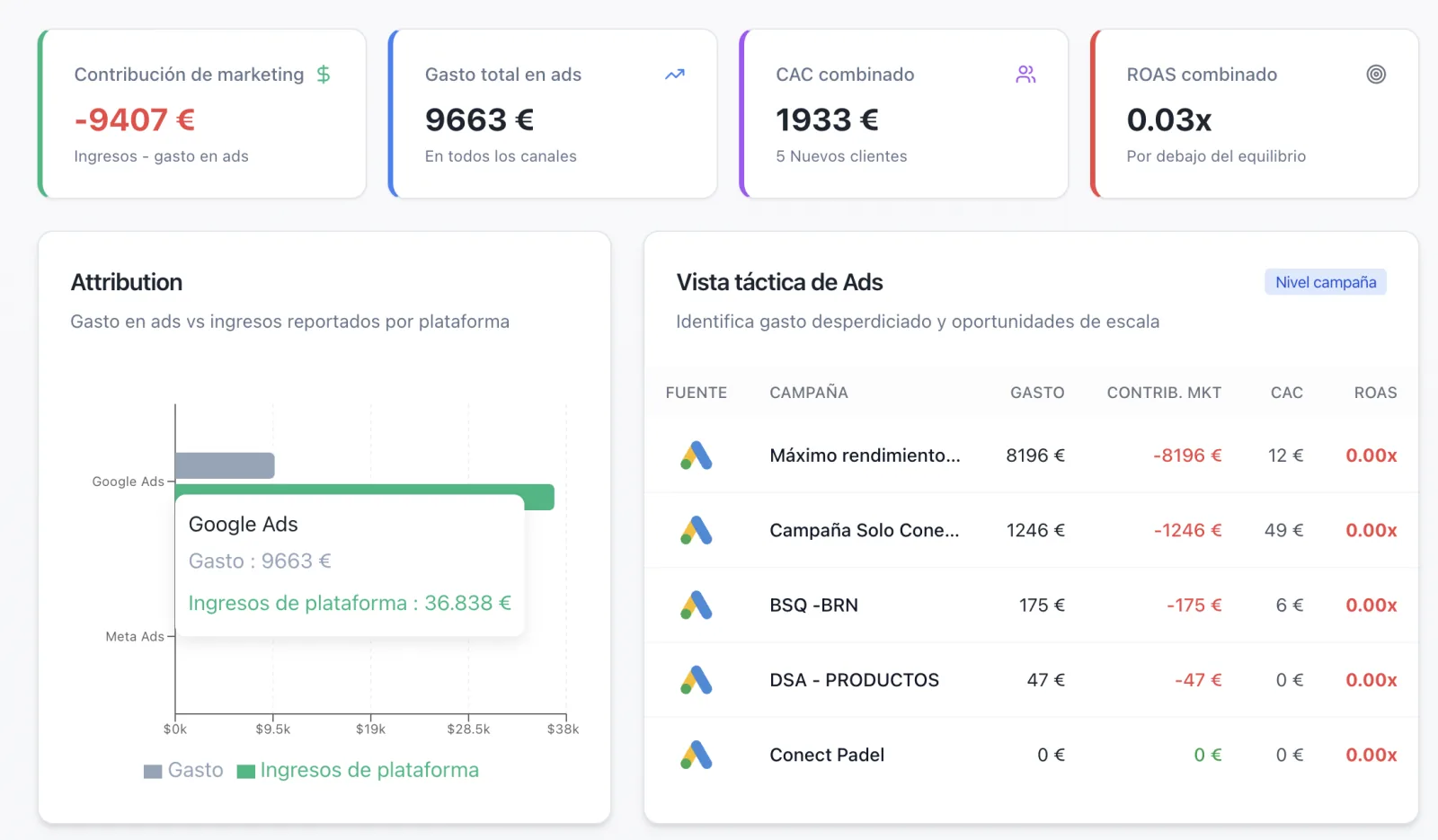
It's the hardest pattern to implement and the most differentiating. The accounts that truly perform cross-reference at least monthly with real Shopify data: real ROAS, product mix, margin, repeat purchases. Most don't do it, operate on reported ROAS, and never know which campaign generates profitable business and which generates paper revenue.
If you could only implement one of the five, this one. But the five together is what separates an account that contributes from one that only spends.
Sources
- Google Ads Help
Tipos de concordancia en Google Ads - Google Ads Help
Acerca del seguimiento de conversiones
Frequently asked questions
How long does it take to apply the 5 patterns?
Structure and feed: 2-4 weeks. Weekly negatives: a permanent routine. Supervised automation: 1 month to stabilize. Cross-referencing with the store: 2-3 months if nothing is set up, 1 week if you already have a unified dashboard.
Do these patterns apply to small accounts (<€5,000/month)?
Structure and feed, yes. Negatives too. Supervised automation only if you reach the minimum conversion volume the algorithm needs (50 conversions a month per campaign). Cross-referencing with the store always.
Can an agency apply these patterns?
The first 4, yes, most do. The fifth (cross-referencing with the store) usually depends on the brand providing the data. It's the question worth asking when choosing an agency: do they optimize with platform ROAS or with the real one?