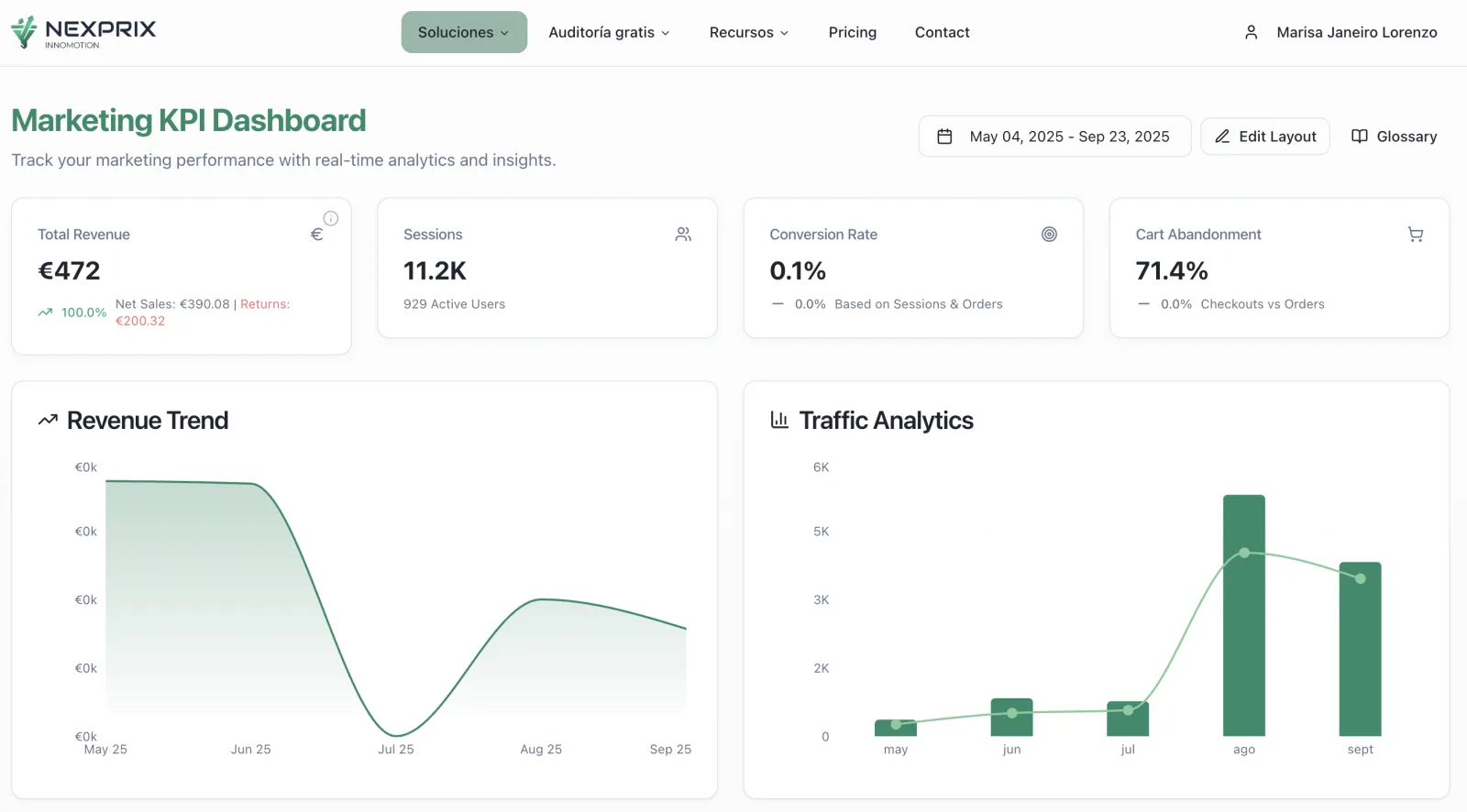
The KPIs commerce managers should check every week
By Manu Santana Founder of Nexprix · Meet the teamIn 30 secondsA commerce manager tracks more than 80 potential metrics, but only six deserve a weekly review because a change in them leads to a concrete decision. The six: cumulative revenue vs the month's target, ROAS cross-checked against the store by channel, total conversion rate and by device, real cost per acquisition, stock of the ten best-selling SKUs, and support tickets plus return rate. The ones that only distract if you check them weekly are total sessions, global bounce rate, campaign CTR and LTV: they don't move within seven days or they're platform metrics with no business read. The review is 30 minutes every Monday with the same six, same format, week after week: if one moves more than the threshold, you open an investigation; if they're in range, the team focuses on what was already planned. Consistency is what turns a metric into a signal.
If you listed every metric a commerce manager looks at, you'd get more than 80. Most don't deserve your weekly attention. These are the ones that do.
The criterion: only actionable metrics
A metric is actionable when a change in it leads you to make a specific decision. If the number goes up or down and you change nothing, the metric isn't for weekly review — it's for quarterly reporting.
The 6 you do check every week
- Cumulative revenue vs the month's target (if you're behind, the decision is to raise pressure on the channels with higher conversion)
- ROAS cross-checked against the store by channel (if it drops >10%, review creative and keyword/product match)
- Total conversion rate and by device (if it falls, you run the 4-cause diagnosis)
- Real cost per acquisition (if it rises >15%, auction pressure or a change in traffic mix — review it)
- Stock of the 10 best-selling SKUs (if a stockout is forecast in the next 14 days, adjust spend)
- Support tickets and return rate (if they rise, there's a problem no number of ads will cover up)
The ones that only distract if you check them weekly
- Total sessions — they go up or down with channel mix, not business health
- Global bounce rate — without page context it's noise
- Campaign CTR — a platform metric, not a business one
- LTV — it doesn't move weekly, monthly or quarterly is enough
How to organize the review
Every Monday, 30 minutes. Same 6 metrics, same format, week after week. If one moves more than the threshold, open an investigation that week. If they're all in range, the team focuses on what was already planned.
The most common mistake isn't picking the wrong metrics. It's changing the list every time someone suggests looking at something new. Consistency is what turns a metric into a signal.
Sources
- Think with Google
Estrategias de datos y medición - Shopify
Coste de adquisición de cliente (CAC)
Frequently asked questions
What if the team is just 1 person?
The same 6. The only thing that changes is that there's no one to delegate the investigations to. That's why it pays to automate the alerts: don't chase the data, be chased by it.
When should I add metrics to the list?
When a recurring decision can't be made well with the ones you have. If you've spent a month saying "I don't know what to do about X", that's a sign a metric is missing.
What about channel-specific KPIs?
They live in their own panels. The weekly review is about the business, not the channel. The per-channel review happens when the business KPIs point you there.