How to lose sales without cutting your prices: the relative price effect
By Manu Santana Founder of Nexprix · Meet the teamIn 30 secondsYou've gone three months without touching prices and conversion drops 8%. The cause isn't in your store: a customer decides to buy based on the relative price ("of the options I see, this is the best value for money"), not the absolute one. If a competitor drops from €49.95 to €44.95, your position breaks without you moving anything and Google Shopping lowers you in the ranking, so you get fewer visits at the same conversion and therefore fewer sales. Looking only at conversion rate won't find the problem: you have to cross product-page visits with Shopping position and the relative price of the three main competitors. For the SKUs that drive 80% of revenue, define your competitive set of 5-10 real competitors and alert when your relative position shifts two places in less than seven days: then you decide whether to defend margin or defend position.
You've gone three months without touching prices. Your conversion rate drops 8%. The cause isn't in your store. It's outside, and it's called the relative price effect.
The absolute price doesn't decide. The relative one does
A customer rarely buys based on "this product costs €49.95 and I can afford it". They buy based on "of the options I see, this is the one that gives me the best value for money".
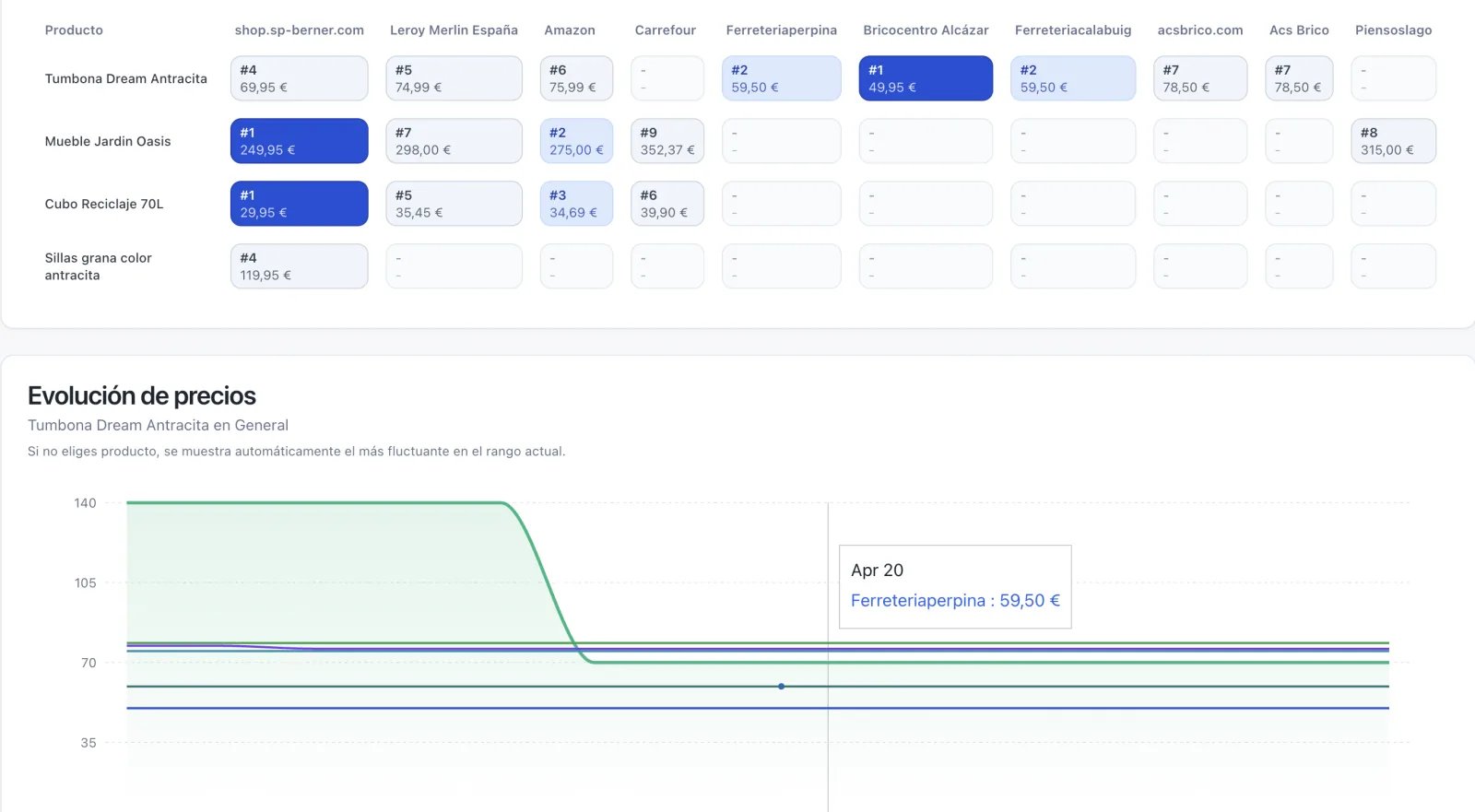
If a competitor drops their price from €49.95 to €44.95, your product hasn't gone up. But your relative position has broken. And conversion drops without you moving anything.
The mechanism in Google Shopping
Google shows products ordered by a mix of relevance and competitive price. If you drop in position because your relative price has worsened, you get fewer clicks even if your CTR per click is unchanged. Fewer visits at the same conversion = fewer sales.
- Product-page visits: down
- Conversion per visit: stable
- Total sales: down
Looking only at conversion leads you to never find the problem. You'll see it when you cross product-page visits with average Shopping position and the relative price of the 3 main competitors.
How to monitor relative price without obsessing
- Define your competitive set: 5-10 real competitors (not everyone out there)
- For the SKUs that drive 80% of revenue, measure the set's average price and your relative position (1 = most expensive, last = cheapest)
- Alert when your relative position shifts 2 places in less than 7 days
- Then decide: defend price (margin) or defend position (volume)
When to defend position and when to defend margin
Defending position makes sense on hero SKUs (the ones that capture the customer who then comes in to buy others), in commoditized categories and in key periods (Black Friday, sales). For the rest, defending margin usually wins in the long run.
The most common mistake is always defending position. It leads to a price war where the only winner is whoever has the greater capacity to absorb margin — usually Amazon.
Sources
Frequently asked questions
How much does conversion drop for each euro of difference with the competitor?
It depends on the sector and the price range. In mid-range electronics, €1 below the cheapest competitor can move up to 5% of the SKU's sales.
Do you have to defend price on every SKU?
No. Only on high-visibility ones and those that capture new traffic. On long-tail SKUs relative price matters less because the customer already comes with intent.
Is it worth entering a price war?
Almost never, unless you have a cost structure clearly lower than the rest of the sector. For most, defending margin and differentiating on service wins in the long run.