Real CAC vs the CAC You Think You Have
By Manu Santana Founder of Nexprix · Meet the teamIn 30 secondsThe CAC shown in the Google Ads dashboard isn't your CAC: it's the Google Ads CAC, calculated as that platform's spend divided by the customers attributed on that platform. Real CAC is calculated as total marketing and sales spend (paid ads, prorated salaries, tools, content produced during the period) divided by new customers in the period, without counting repeat purchases or renewed subscriptions that inflate the numerator. If you only look at the per-platform CAC, each channel seems to work reasonably well. If you look at the real CAC, you often discover that it costs more to acquire a customer than the average order value lets you recover on the first order. Before doubling your ad spend, calculate the real CAC of the last 90 days and compare it with the 12-month LTV: if the LTV/CAC ratio is below 3, don't scale, optimize.
The CAC shown in the Google Ads dashboard isn't your CAC. It's the Google Ads CAC. To scale your ecommerce sensibly, you need the other number.
The formula most people use (and that's wrong)
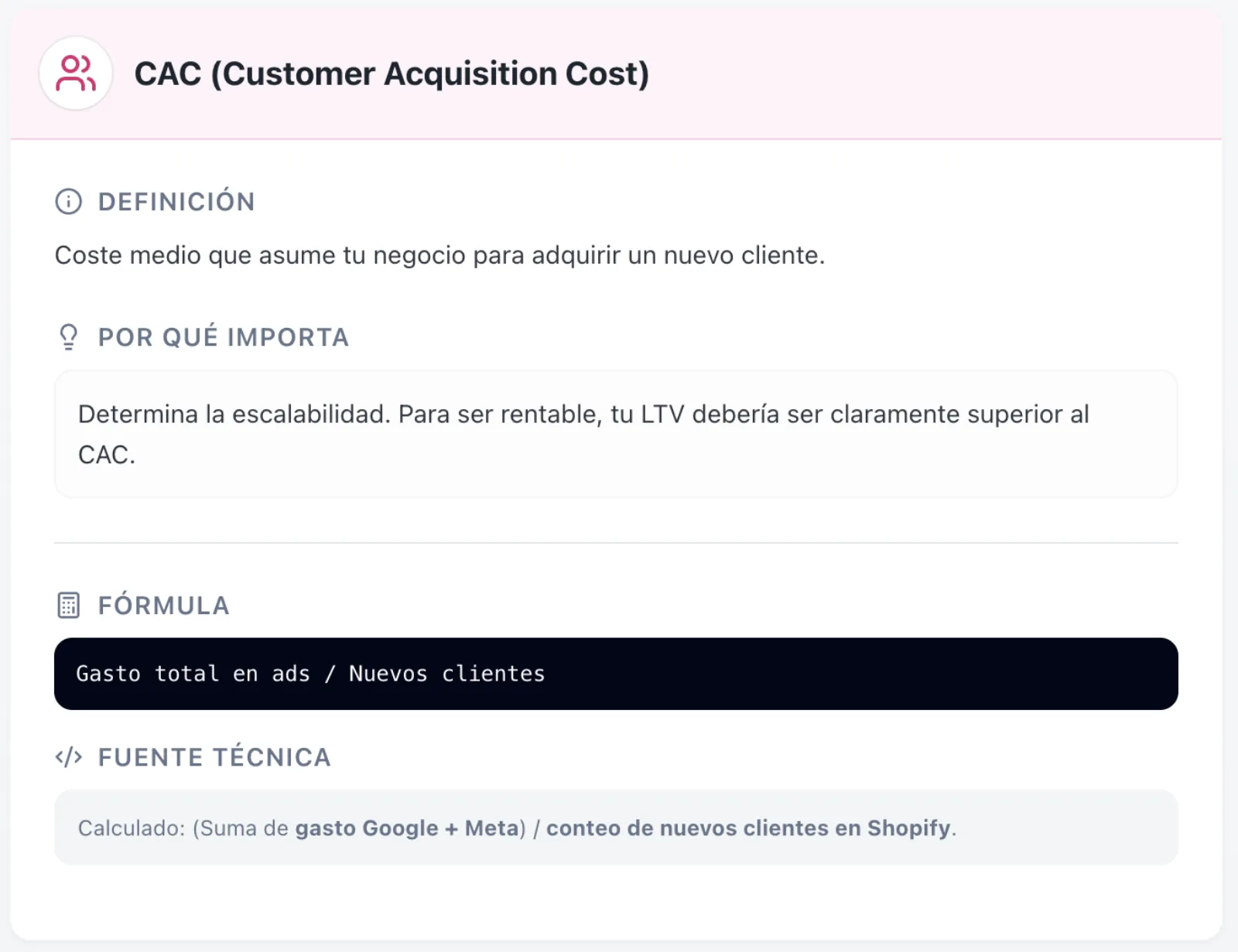
Platform CAC = spend on that platform / customers attributed on that platform. It's what Google Ads, Meta Ads or any other shows. It doesn't include the rest of the channels that touched the customer before buying.
The correct formula
Real CAC = total marketing and sales spend / new customers in the period. It sounds simple. The catch is what you include on each side.
- Spend on paid ads (Google Ads, Meta Ads, TikTok Ads, etc.)
- Marketing and sales team cost (salaries and prorations)
- Tooling cost (Shopify Plus, automation, analytics)
- Cost of content produced during the period if you pay for it
On the customer side, count only new ones. Repeat purchases and renewed subscriptions inflate the numerator and artificially lower the CAC.
Why cross-referencing channels matters
The Google Ads CAC of a customer who also saw Meta Ads and arrived via organic tells you how much you paid Google for that customer. But that customer was touched by three channels. The real CAC splits the cost across all three.
If you only look at the per-platform CAC, each channel seems to work reasonably well. If you look at the real CAC, you discover it costs more to acquire a customer than the average order value lets you recover on the first order.
Apply this correction before scaling
If you're going to double your ad spend, first calculate the real CAC of the last 90 days and compare it with the 12-month LTV. If the real CAC is close to or above the first-purchase LTV, doubling spend will double losses, not sales.
- Calculate real CAC every quarter
- Compare against 12-month LTV, not against average order value
- If the LTV/CAC ratio is below 3, don't scale: optimize
Sources
- Shopify
Customer Acquisition Cost: How to Calculate CAC - Think with Google
Data and Measurement
Frequently asked questions
Should salaries be included in the CAC?
Yes, if you want a defensible CAC for investors or strategic decisions. For daily tactical optimization it's usually excluded so the number is more volatile and reactive.
What about multi-touch attribution?
It helps split credit across channels but it doesn't change the total CAC. Real CAC is still total spend / new customers.
How often should I recalculate CAC?
Monthly at the operational level. Quarterly for strategic decisions (planning, hiring, the year's budget).