What it really means when your conversion rate drops 15%
By Manu Santana Founder of Nexprix · Meet the teamIn 30 secondsA 15% drop in conversion rate doesn't mean something is broken: it means something has changed, and confusing the four possible causes wastes weeks on optimizations that never touch the problem. Cause one: a change in traffic mix (awareness campaigns or cold Meta Ads bring users who weren't looking for the product). Cause two: a change in product or catalog (a price increase, pulling the hero product, a key stockout). Cause three: a technical change in the funnel (a deploy, a misconfigured A/B test, a pixel failure, new checkout slowness). Cause four: competitive pressure (a competitor has cut prices or brought a promotion forward). Each cause demands a different response. To diagnose it in an hour you only need four cuts: conversion by source, conversion by product, the step-by-step funnel and a price comparison on the most-visited SKUs.
Your conversion rate is 15% below last month. Before you touch anything, you need to diagnose. The 4 possible causes call for different operational responses — confusing them wastes weeks on optimizations that never touch the problem.
Cause 1: a change in traffic mix
If you've launched an awareness or cold Meta Ads campaign, you're bringing in users who weren't looking for the product. Overall conversion drops without anything being broken in the funnel.
- Compare conversion by traffic source before and after the drop
- If conversion per source is stable but the mix has changed, it's noise, not signal
- Decision: don't touch the funnel, adjust expectations or reallocate spend
Cause 2: a change in product or catalog
You've raised a price, pulled the hero product, run out of a key SKU. Conversion drops because the catalog no longer answers the visitor's intent.
- Check which products get the most visits on the pages losing conversion
- Compare available stock and price vs the previous period
- Decision: rotate the catalog on home and category pages, or raise the price gradually instead of all at once
Cause 3: a technical change in the funnel
A launch, a deploy, a misconfigured A/B test, a pixel failure, new checkout slowness. The easiest to rule out and the easiest to overlook.
- Check Lighthouse and Core Web Vitals on Monday vs the previous Monday
- Verify that checkout events are still firing correctly
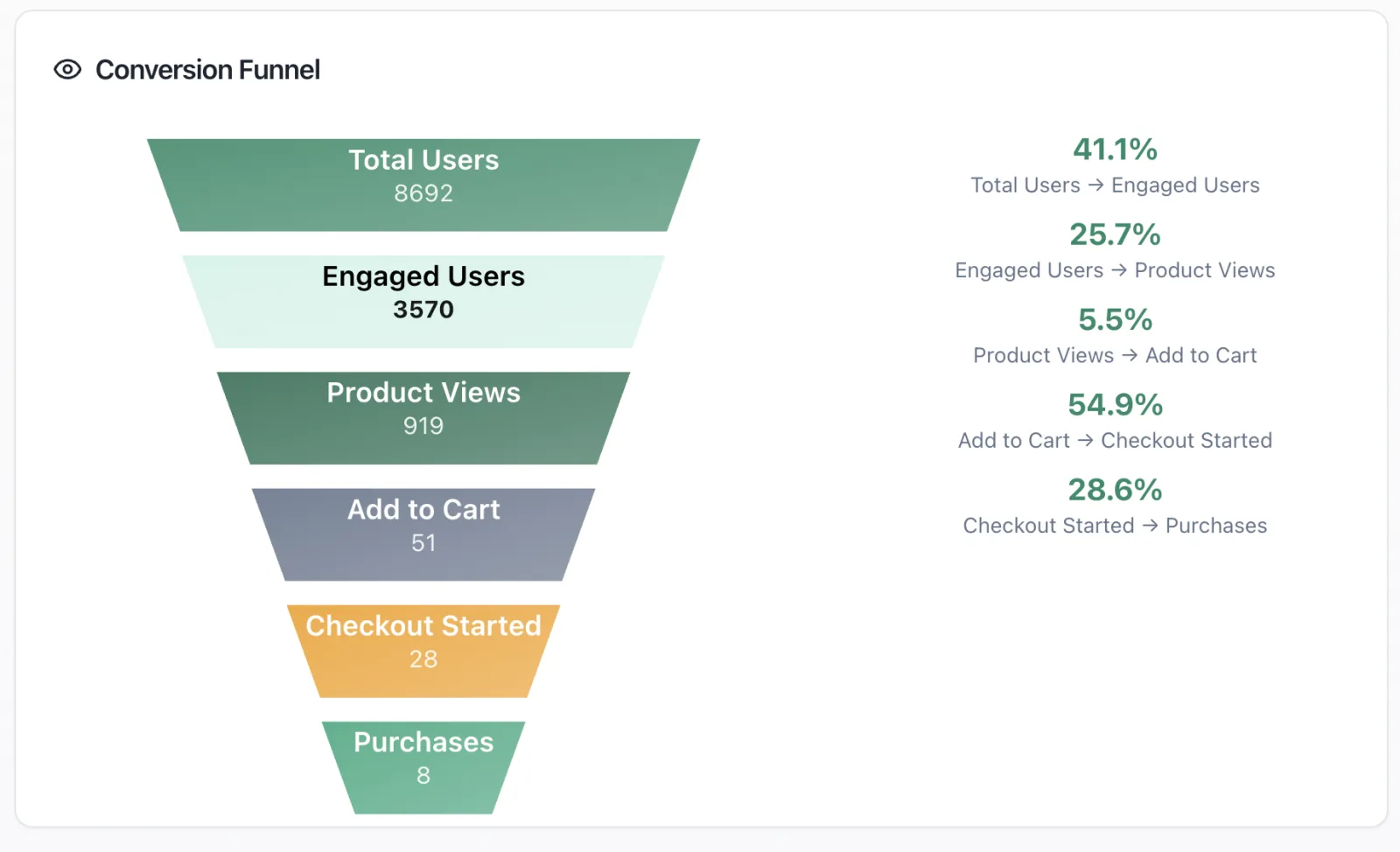
- Look at the funnel step by step: where it's dropping (product page, cart, checkout)
Cause 4: competitive pressure
A competitor has cut prices. A competitor's early Black Friday campaign is stealing demand. An aggressive promotion on Amazon. Conversion drops because your relative proposition has shifted.
- Check competitor prices on the most-visited SKUs
- Look at search trends for your brand vs the category over the last 30 days
- Decision: tactical defense (a targeted price cut, a promo) or offense (better copy, more value argumentation)
Diagnosis before treatment
A 15% drop isn't fixed with the solution that worked for the director's friend. It's fixed by first identifying which of the 4 causes (or which combination) is active. Confusing the causes wastes weeks on optimizations that never touch the real problem.
Sources
- Shopify
Tasa de conversión por sector ecommerce (benchmarks 2025) - Google Analytics Help
GA4 — análisis de embudo paso a paso (funnel exploration) - Google Analytics Help
Modelos de atribución y su impacto en la medición de conversión
Frequently asked questions
Which of the 4 is most common?
A change in traffic mix is the first one. When a new channel is launched or money goes into awareness, overall conversion drops even though the business is growing.
When should I alert the team?
If the drop exceeds 20% in the month and isn't explained by traffic mix. Below that, monitor for one more week before moving resources.
How do you separate the 4 causes in an analysis?
Conversion by source (cause 1), conversion by product (cause 2), the step-by-step funnel (cause 3), a price comparison (cause 4). If you have the 4 cuts on hand, one hour of analysis is enough.