I Asked an AI to Audit a Google Ads Account. Here's What It Found
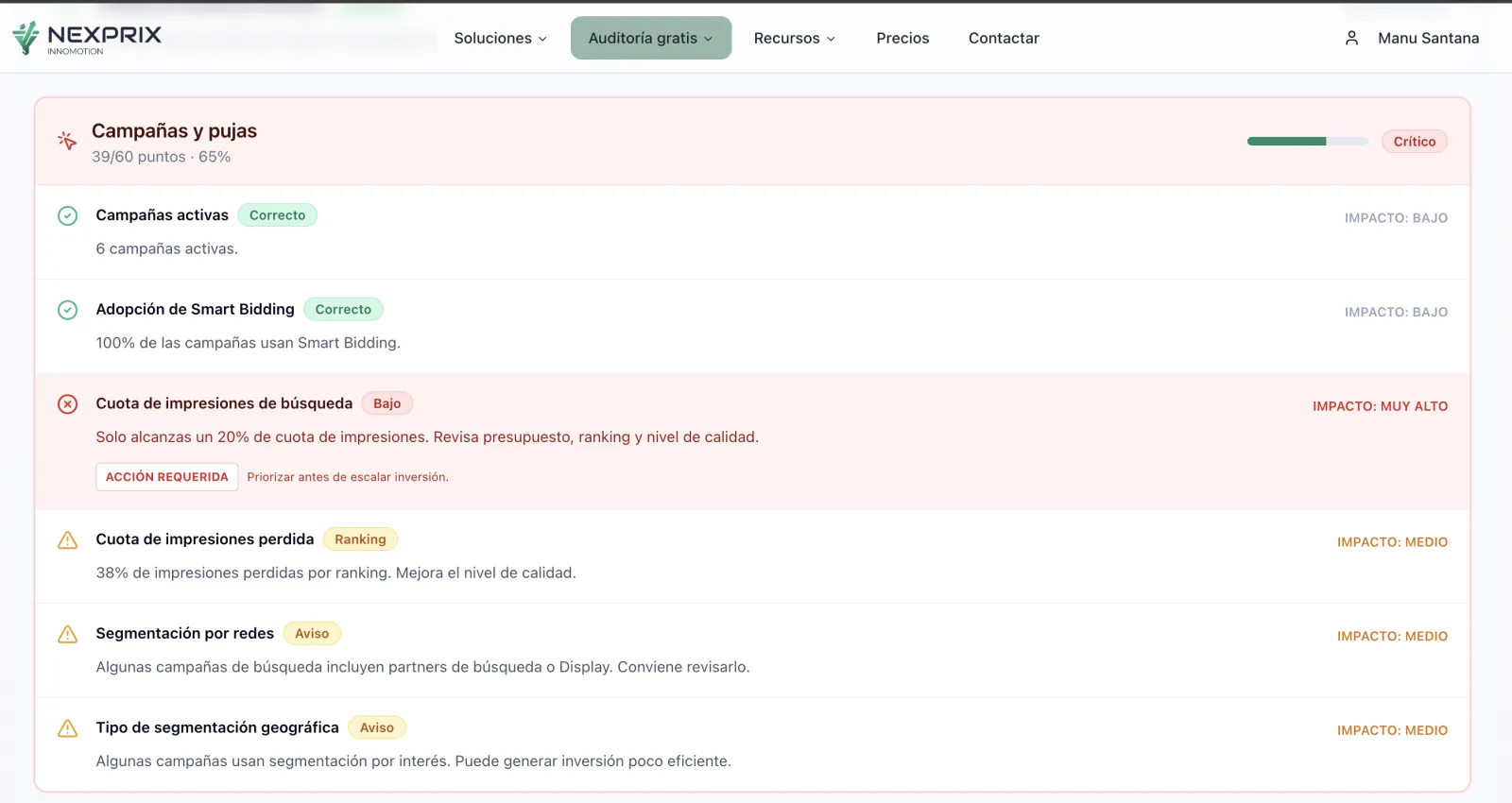
By Manu Santana Founder of Nexprix · Meet the teamIn 30 secondsA Google Ads account spending €12,000/month with a reported ROAS of 4.2x looked healthy until the data was cross-referenced with real Shopify revenue: the real ROAS was 2.1x, half of it. The cause was duplicate attribution: Google Ads and Meta Ads were both claiming the same conversions, and the team only looked at the number each platform reported. An automated 3-minute audit detected three additional problems: 34% of the budget in broad match without a single negative keyword configured, two campaigns cannibalizing each other for the same searches, and ad groups with more than 15 keywords with no thematic segmentation. None of them were invisible: they were in the data, they just needed to be cross-referenced. If you manage more than €3,000/month in Google Ads, cross-reference the ROAS the platform reports with your store's real revenue: when the gap exceeds 15%, there's duplicate attribution and wasted budget.
The account showed a reported ROAS of 4.2x in Google Ads. A number the team presented in its weekly meetings as a sign that everything was going well.
When we cross-referenced that figure with real Shopify revenue, the real ROAS was 2.1x. Half. The gap was explained by duplicate attribution: Google Ads was claiming conversions that Meta had also claimed. Nobody had spotted it because nobody had cross-referenced the data.
What the auditor found in 3 minutes
- 34% of the budget in broad match without a single negative keyword configured
- 2 campaigns competing against each other for the same searches, directly cannibalizing budget
- ROAS in Google Ads: 4.2x — real ROAS cross-referenced with Shopify: 2.1x
- Ad groups with more than 15 keywords with no thematic segmentation
None of these problems were invisible. They were in the data. What was missing was cross-referencing and reading them together.
Why this happens
The team reviewed the Google Ads ROAS every week. The agency delivered reports with that same number. But nobody had easy access to real Shopify revenue segmented by channel and by campaign.
This isn't an extreme case. It's the most common one. When your reference figure is the one given to you by the very platform that wants you to keep investing in it, the bias is structural.
What to do if you manage more than €3,000/month in Google Ads
- Cross-reference your Google Ads ROAS with your store's real revenue. If the gap exceeds 15%, there's duplicate attribution
- Review last month's search terms. If irrelevant searches are getting clicks, you have wasted budget
- Check whether you have branded and non-branded campaigns sharing a budget. The branded one always wins and the non-branded one never scales
- Audit at the right frequency: at least every 3 months if spend exceeds €5,000/month
Nexprix's free Google Ads auditor runs this review automatically: you connect your Google Ads (AdWords) account, it cross-references the data with your store and returns a diagnosis in minutes. If you want the long, step-by-step version of the process, here's the complete guide to auditing Google Ads in 2026.
Sources
- Google Ads Help
Tipos de concordancia en Google Ads - Google Analytics Help
Modelos de atribución en Google Analytics 4
Frequently asked questions
How long does it take to audit a Google Ads account?
Nexprix's free Google Ads audit (https://nexprix.com/google-ads-audit) analyzes an account in under 5 minutes. It doesn't require exporting data manually: it connects directly to your account via API with read-only permissions.
What do I need to use the auditor?
Read-only access to your Google Ads account and, optionally, a Shopify connection to cross-reference real revenue.
How often should I audit my account?
For accounts spending more than €3,000/month (or the local equivalent in LATAM), we recommend auditing at least every 3 months. With the automated auditor you can do it monthly at no additional time cost.